
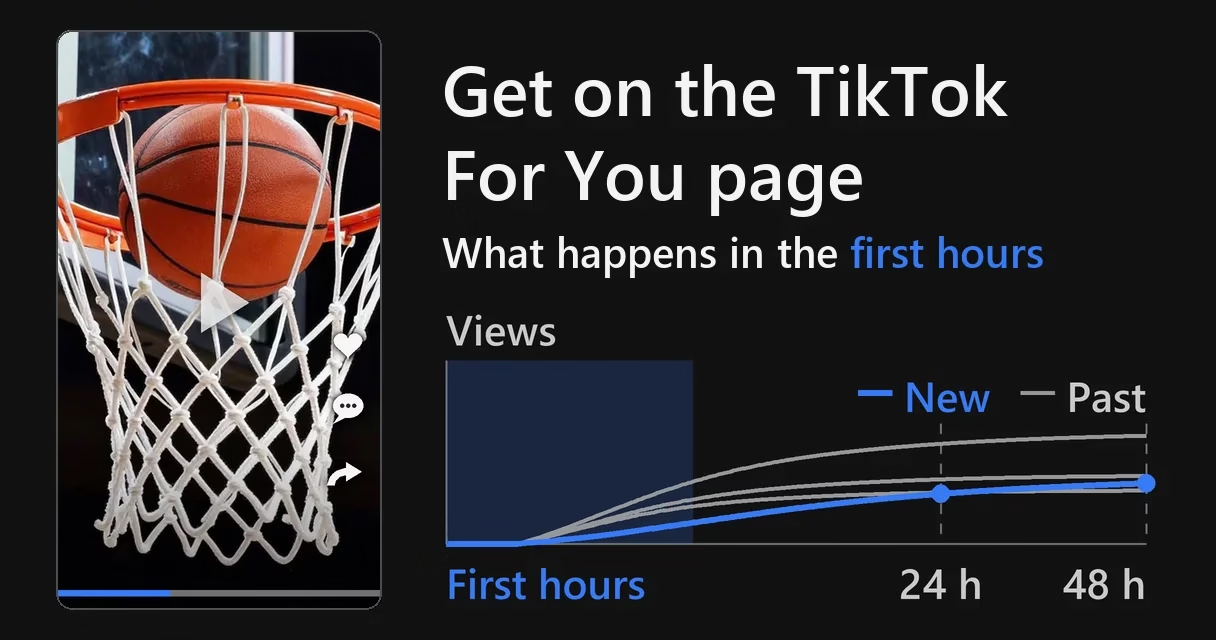
The video is out. It gets 200 views. Then the counter stops. A post on the CPA.Club forum opens with the question: “Is 200 views your ceiling?” 12.
Getting on the For You page on TikTok makes more sense once you know what happens to a video in its first hours. TikTok’s recommendations are the For You feed. In the Russian versions of TikTok’s creator articles, it is most often called the “Recommendations” feed 23, and sometimes “For you” (Dlya vas) 22. First, the video goes through moderation. Until then, it is not recommended to anyone 1. After that, a ranking system decides on each impression based on how viewers react and on information about the video 2. Interest usually peaks soon after publishing, TikTok wrote in 2020 3. The full result builds up over a couple of days 3. TikTok’s documents contain no 200-view threshold, although on our own account video views did stop at about that number. More on that below.
What to do to get on the For You page. Publish a new video, not a re-upload of an old one. Grab attention in the first three seconds. Use hashtags that match the video’s topic, not #FYP. Judge by several videos in a row, not by the first hour. Details below.
We are the Video Unique Booster team. Our program makes copies of a video with different frame and sound edits. We read TikTok’s documents and three academic papers. We also reviewed nine articles and eleven YouTube videos about getting into recommendations. We collected the search results, documents and videos on September 26, 2026. When we write “TikTok’s documents don’t say this”, we mean the documents in the “Sources” list at the end of the article.
Our own TikTok experience is narrow. It is a test in September 2026 on one account of our own, with no links and no traffic. We published uniquified copies of videos there. We looked at one thing: whether they passed TikTok’s checks and got views. Most did. We took the video analytics of this account on September 27. They are below, at the end of the section on the “200-view threshold”. The article’s advice does not rest on this test. We have more experience on Instagram: a Reels network of about 300 accounts, March to August 2025. Where it is relevant, we refer to it and name the platform.
Who this article is for
For those who publish videos and watch their views in the first hours. For creators who run several accounts. For affiliate marketers who get traffic from TikTok.
Not for those who want to change their own feed. The Russian query “how to set up recommendations on TikTok” is searched 390 times a month, according to Google Keyword Planner. But that is a viewer’s question. This article asks a different one. How does a video get into other people’s feeds?
Video Unique Booster for Windows: hundreds of unique copies in one goBy hand, you edit copy after copy. The program creates them in batches. Each copy gets its own image, sound, metadata and duration.
Video Unique Booster: video uniquification for WindowsYou add a video and set the setting ranges. The program creates hundreds of copies. Each has its own image, sound and duration.
Hundreds of unique copies from one original videoThe manual way runs into one problem. Each copy has to be edited separately. More copies take more time.
Unique video copies for TikTok, YouTube and InstagramYou set the setting ranges once. Then the Windows program creates copies in batches. Hundreds in one go.
Video uniquification for Windows – Video Unique BoosterYou add one video. The program creates hundreds of copies. Each has its own image, sound, metadata and duration.
What you will need
- a TikTok account and its analytics in TikTok Studio;
- a new video, not a re-upload of an old one;
- several videos in a row;
- a spreadsheet where you will record the result of each video.
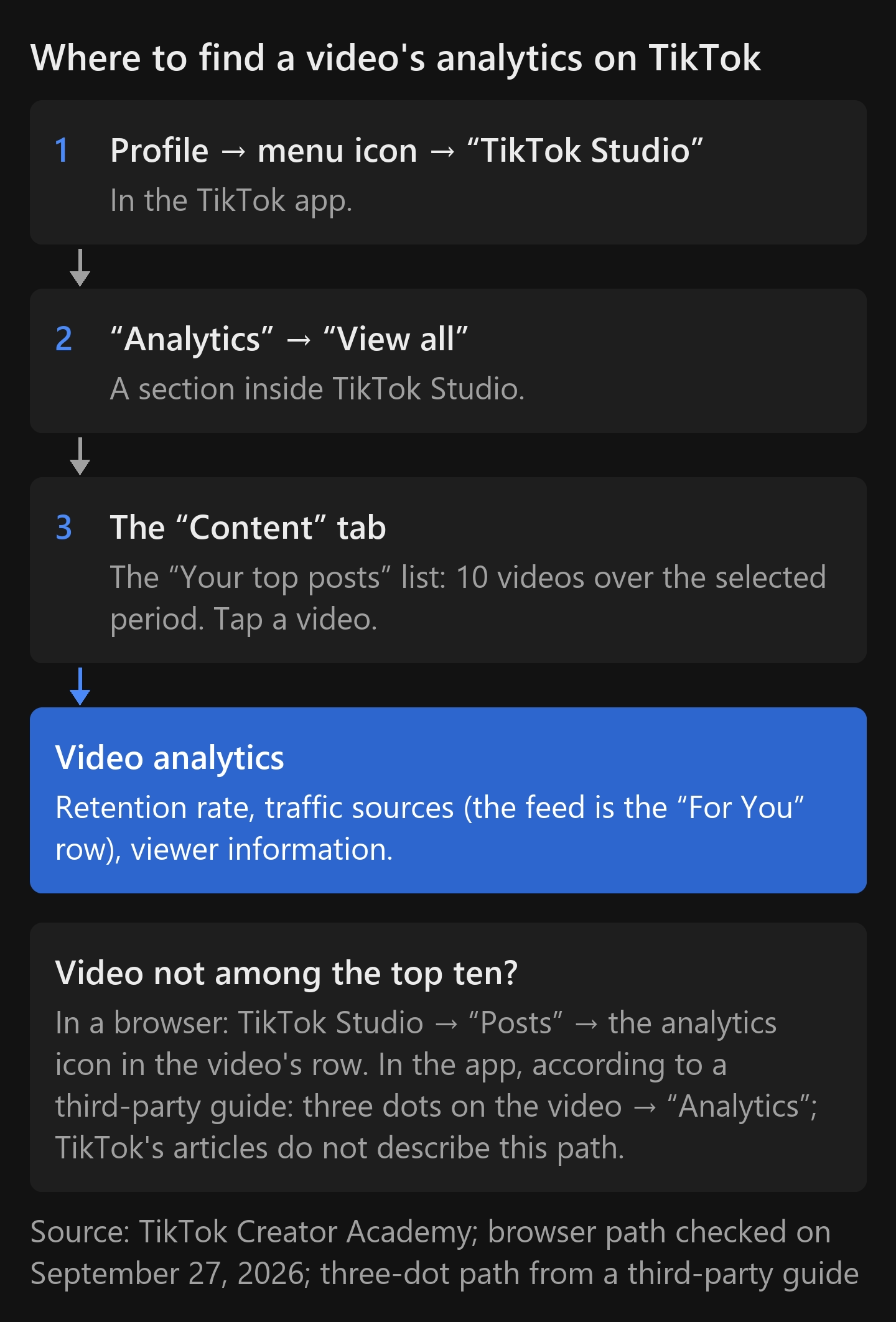
Where to find the analytics. In the TikTok app, open your profile, tap the menu icon and select “TikTok Studio”. There, find the “Analytics” section and tap “View all” 26. The analytics of a single video are in the “Content” tab. It has a “Your top posts” list: 10 videos over the selected period 21. Tap a video. You will see its retention rate, traffic sources and viewer information 21. Is the video not among the top ten? A third-party guide gives this path: open the video itself, tap the three dots and select “Analytics” 25. TikTok’s articles do not describe this path, and in your version of the app the item may be named differently. In a browser the path is shorter; we checked it on September 27, 2026. Open TikTok Studio on tiktok.com and go to the “Posts” section. Each video’s row has an analytics icon.
The first minutes: moderation first, then recommendations
TikTok’s Transparency Center describes the order directly 1. A new video goes through moderation first. It is done by automated systems and by people. Videos that violate the rules are removed. A video that is not suitable for a broad audience is not made eligible for recommendations. In TikTok’s words: “Only videos that pass moderation are included in the pool of videos that can be recommended” 1.

TikTok’s 2020 article says the same thing from another angle 2. A newly uploaded video and a video under review may be ineligible for recommendation.
So zero views in the first minutes may mean the video is still under review. TikTok’s documents do not say how long the review takes. Still zero, and the video went out long ago? Read our analysis 0 views on TikTok (in Russian). It walks through the checks step by step.
The five steps of the TikTok algorithm: what the next impression depends on
TikTok describes its recommendation algorithm in five steps 1:
- Selecting candidate videos.
- Predicting how interesting a video will be to the viewer.
- Ranking.
- A similarity check.
- Recommendation rules.
These steps describe one refresh of one viewer’s feed. Such refreshes happen again and again. Each time, your video is compared with other candidates for a specific person. This description contains no view threshold.
TikTok describes what the prediction takes into account in words, without numbers. A strong sign of interest is a viewer watching a longer video to the end. A weak one is the viewer and the creator being in the same country. A strong signal carries more weight 2. The tips for creators put it more briefly: “Watch time factors into how a video gets recommended” 3. In other words, watch time affects recommendations 3. TikTok’s documents give no completion percentages.
Follower count and past high-performing videos are not direct factors in recommendations 2. A video from a large account is likely to get more views, thanks to its followers 2.
On Instagram, we saw views come without followers. In a snapshot of 217 accounts from our Reels network (part of the network), all the accounts together had 141 followers. Views still came in, and they came from the recommendation feed.
In 2022, Maximilian Boeker and Aleksandra Urman studied the TikTok feed using bots 4. The bots followed creators, liked videos and watched them sometimes partially, sometimes several times over. The researchers looked at how this changed the bot’s own feed. Following had the strongest effect, then the share of the video watched, then likes 4. This is the order for a viewer’s feed, not for how your video is shown. They have no “70% completion” threshold either.
Which metric should a creator watch? TikTok’s learning section for creators answers directly: retention first of all 20. Second in importance is engagement: likes, comments and shares. TikTok gives more weight to watch time than to likes, comments and shares. But a video’s success, it says, depends on all of these metrics 20. In a video’s analytics, retention and watch time show up as three numbers 21. Retention rate: what percentage of the video was watched and where viewers left. The second is average watch time. And “Watched full video”: the share of people who watched to the last few seconds. It depends on the length of the video 21.
What to change in your next video
The advice below comes from TikTok. The sources are a 2020 article with tips for creators 3, an article about recommendations 2, learning articles for creators 2022 and the Community Guidelines 8. We have not tested our own TikTok videos against this advice. Where we have Instagram experience, we say so. What is said only in YouTube videos is marked separately.
Idea. To stand out in the feed, TikTok advises making detailed videos that teach something 22. Format examples from the same source 22: solving a simple everyday problem, debunking a myth, a life hack, replying to a comment with a new video, a step-by-step tutorial with on-screen text.
Format. According to TikTok, vertical videos and videos longer than five seconds perform best 3. TikTok does not name an exact length. Articles in the search results name different lengths, for example 15-20 seconds, with no source given. In its learning section, TikTok itself advises making longer, well-thought-out videos 20. And it calls watching a longer video to the end a strong sign of interest 2. TikTok accepts horizontal videos too: there is no need to add black bars to make them vertical 22.
The first seconds. TikTok names the time frame in a learning article: it is important to hook the viewer in the first 3 seconds 22. The same article gives three techniques 22:
- ask a question at the start that the video will answer;
- add a timer or put the time in the title;
- open with a quick look at the finished result, then show the whole process.
An example of the third technique. A video about fixing a bicycle chain opens with a shot of the repaired chain already spinning. Retention will show whether the opening worked 20. TikTok’s own example: most viewers left at 00:02 20. Then rewatch what is happening in the video at that moment. Is there no story hook? Is the editing weak? Could the opening offend viewers? Is it interesting to an ordinary viewer 20? The creator of the crystal.beetle channel also talks about the three seconds 14.
Topical hashtags. TikTok advises using hashtags that describe the video itself. More hashtags do not guarantee more reach 3. The #FYP and #ForYou hashtags work like any others 3. On their own, they do not necessarily improve the chances of getting into the feed 3. An example: a video about fixing a chain gets #bikerepair and #bicycle, not #fyp and #foryoupage.
Caption and title. TikTok advises using the caption to give context and tell more about the video 3. The analytics will suggest the words for the caption and title. A video’s traffic sources show the search queries that brought people to it 20. TikTok advises putting these queries into the titles of your next videos on the same topic 20.
Publishing time. The “Followers” tab of the analytics shows when your followers are active, by day and hour 2021. TikTok advises publishing on the most active days of the week and no earlier than two hours before the peak 20. No followers yet? The “Viewers” tab shows your viewers’ most active times over the last 7 days 21.
Sound and format by the numbers. An added sound connects the video with viewers who like that sound 3. It also helps people find the video through sound search 3. You can check whether sound helps you in the traffic sources. If videos with popular sounds get more traffic, TikTok advises keeping an eye on trending sounds 20. The same goes for format. If, for example, videos with the green screen effect get more traffic from the For You feed, TikTok advises making them regularly 20.
Experiments. The number of videos you publish does not affect recommendations 3. Try different formats and see what performs better.
What not to do. Reused or unoriginal material without creative edits is not eligible for the For You feed. An example from the rules is a clip with someone else’s watermark or logo. Low-quality or minimally edited material, such as a short clip made only of GIFs, is not eligible either 8. A video that tries to artificially increase traffic may also be ineligible 2. TikTok removes fake likes and fake followers 8. Artificially inflating views is not a way to get into recommendations.
Warming up the account. The advice to scroll the feed for two or three days before publishing appears in three videos in our sample. All three are from the same channel, sindikat 161718. Two of them advise scrolling the feed in your own niche 1718. TikTok’s documents say nothing at all about warming up. Boeker and Urman showed that views and follows change the account’s own feed 4. But that is the feed you see. None of our sources checked whether warming up affects how your videos are shown to others.
The peak comes fast, the full result takes a couple of days
TikTok writes that new videos usually see peak engagement soon after publishing 3. The result stretches over a couple of days. The advice, word for word: “keep your video up”. That is, don’t take the video down. The same article says that the For You feed usually draws on videos from the last 90 days 3.
In our Instagram Reels network, videos behaved differently. Sometimes a video got no reach on the first day and then gained tens of thousands of views over the next five days. Sometimes it was the other way around: reach on the first day, then growth stopped. These are observations from memory, without counting what share of videos behaved this way. But a video’s result could not always be guessed from its first day. If a video is still growing on the second day, record its numbers again later, for example a week later.
How to judge a video. TikTok advises watching the overall trends in your analytics rather than a single metric like likes or comments 3. Views also vary from video to video 3. So starting with your next video, record views, retention and the share of the For You row in the traffic sources. Record them after one day and after two days. The video’s traffic sources show the feed’s share 20. After several videos, you will see which formats and topics work better for you.
Every account has its own baseline. In the same snapshot of our Reels network, on half of the accounts a video got no more than 30 views on average. Meanwhile, the best video of one account in this snapshot got 1,809. Videos with tens of thousands of views are not in the snapshot: it is incomplete.
We kept similar records in our Instagram Reels network. Every test went into a spreadsheet: what we changed, the result, the conclusion. We tested a video type like this. We published it on part of the network, about 30-50 accounts. After a day or two, we checked whether views and link clicks were coming in. Videos featuring Andrew Tate got views but no clicks. We dropped such videos and tried others. If you send viewers to a link, views alone are not enough to track.
Olga Ulyanova, who runs a channel about TikTok, advises waiting longer, up to a month 13. TikTok does not confirm the one-month period. The 90-day window makes it possible, but no more than that.
Re-uploading the same video: what the rules say
A common question in discussions is whether you can delete a video and upload it again. A thread on Bolshoy Vopros, a Russian-language Q&A site, has ten answers on this 11. Opinions differ 11. One person writes: “People usually re-upload if the first video didn’t get into recs” 11. Two others in the same thread are against re-uploading without changes. One warns of a shadowban 11. The other advises more changes and a new title 11.
TikTok does not write directly about re-uploading your own video. Two places come closest. The 2020 article, in the section on feed diversity: “We also don’t recommend duplicated content” 2. That is, TikTok does not recommend duplicates 2. The second place is the section of the rules on intellectual property. Reused material “without anything new” is not eligible for the For You feed 8. The section is about other people’s material, but this rule in it is stated in general terms. The same file uploaded a second time carries nothing new.
There can be consequences for the account too. Sometimes an account does not break the rules. But it publishes many videos that are ineligible for the feed. Then TikTok may make the whole account and its videos ineligible. They will become harder to find 9. A series of re-uploads with nothing new may affect the whole account.
If a video is ineligible for the feed, TikTok promises to show this in the analytics 1023. The rules do not say how such a notice is labeled.
What gives a fresh start? A new video. Or a video with something new in it: new editing. Plus a different sound and a different caption. A new caption alone may not be enough. Olga Ulyanova says the same 13. The video should be re-edited at least a little and published with a different description 13.
TikTok’s rules allow you to have several accounts of your own, as long as you don’t use them to deceive people or break the rules 8. Automation, scripts and other tricks to get around the systems are prohibited 8. For deceptive account behavior, TikTok may also ban new accounts you create 8. There is no separate rule about the videos on each account. But the rule about material with nothing new applies on any account 8. Olga Ulyanova gives an example: a video shot with a friend and published on both accounts will go into recommendations only where it came out first 13. These rules are covered point by point in the article 0 views on a new account (in Russian).
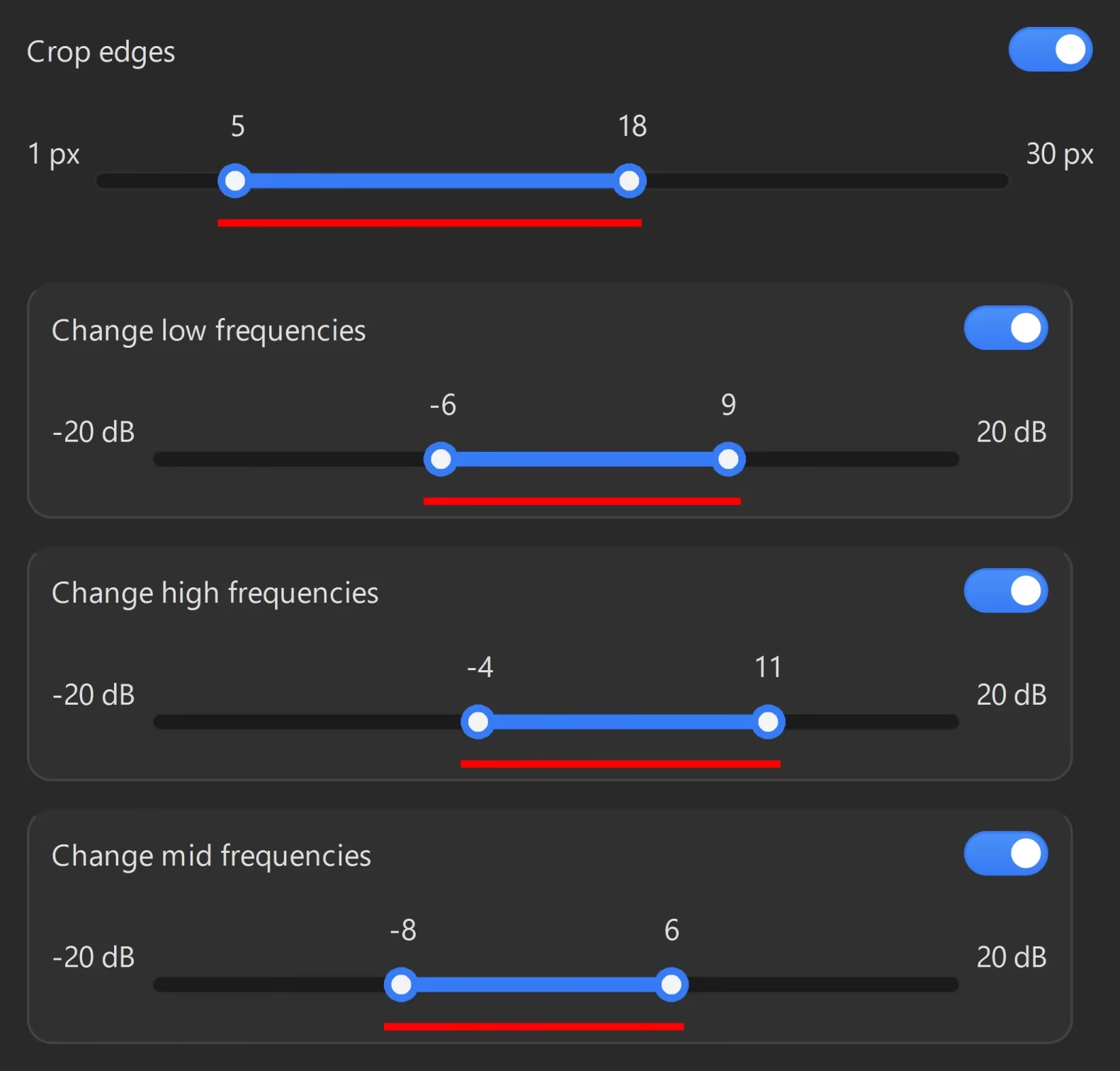
Copies with edits do not override these rules. If the accounts are run by the rules, each one, in our view, needs its own version of the video. How to prepare such versions is covered in the article video uniquification for TikTok (in Russian). You do the new editing and the caption for each one. The sound and frame edits can be handed to Video Unique Booster. The program makes the number of copies you need from one video. It gives each copy its own set of frame and sound edits. For example, it crops the frame edges or changes the low, mid and high frequency levels of the video’s sound. For each copy, it picks the additional audio at random from your set of sounds. The program only prepares the files. It does not run accounts and does not publish videos.
What this gives you with several accounts: the program takes over the manual sound and frame work on each of them. The new content of the video remains yours to make.
In our Instagram Reels network, each account also got its own copy made by this program. But a network is a different way of working than several accounts of your own run by TikTok’s rules. This experience does not transfer directly to such accounts. We did not publish videos without copies in the network. Before it, on one Instagram account of our own, other people’s videos from other social networks, unedited, soon started getting zero views. This is an observation, not a count. Our TikTok test, described at the start of the article, had no comparison with videos without copies. It shows only one thing: most of the copies got views.
For ad accounts, which have their own moderation, copies of ad creatives are covered in the article ad creative uniquifier (in Russian).
Where the “200-view threshold” and the “test group” come from
The takeaway for creators. “200 views” is a number without a source. TikTok’s documents contain no such threshold. The benchmark for your video is your own videos, measured at the same points: after one day and after two days. Below is how we checked this.
We found the figure “200-500 people in 30-90 minutes” on one page, on an English-language website about social media marketing. The page links to TikTok’s article about recommendations 2. But these numbers are not there.
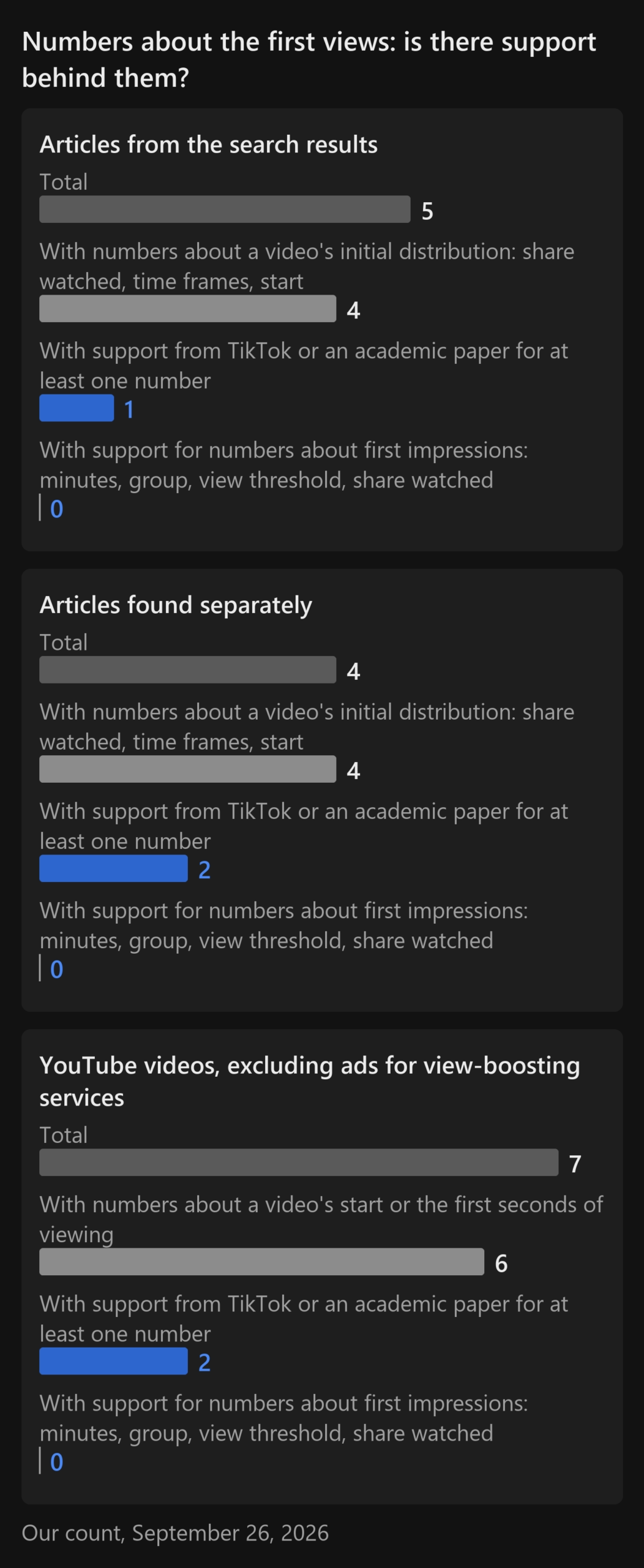
How we searched. We collected the search results for the Russian query “how to get into TikTok recommendations” on September 26, 2026, with search set to the US. Google results seen from another country may differ. Of the nine URLs, six answered this question, judging by their titles. We read five of them, one of the five from a web archive snapshot. The sixth page would not open. We found four more articles separately, by the Russian phrases for “test audience” and “first hours”. We do not give the names or addresses of these pages.
Of the five articles from the search results, four give numbers about a video’s initial distribution. These are the share of the video watched (“more than half”, “more than 50%”), “record views within 1-2 days” and a promise of “2-3 times more views at the start”. Only the last one is specifically about the video’s start. All four articles found separately give numbers. These are the length of the test in minutes, the size of the first group, the share watched and the first seconds. None of the nine links to a study or a TikTok document where these numbers appear. Two articles link to TikTok in general, but not to a place with the numbers. One more links to a third-party social media blog.
Three of the nine articles write directly about a “small test group”. All three are among those found separately.
Then we reviewed eleven videos from the YouTube results for the same query. Four of them turned out to be entirely ads for view-boosting services. Of the other seven, six give numbers about a video’s start or the first seconds of viewing.
We found support for two numbers. The first is “3 seconds” to grab attention. TikTok itself gives this number in a learning article 22. It appears in two videos 1416 and in two of the articles found separately. The second number is a time frame of a day or two. One article in the search results says “within 1-2 days”. TikTok writes that the result stretches over a couple of days 3. The match is partial. Olga Ulyanova gives the same time frame, but for when distribution begins: the video may start being shown “in a day or two” 13. According to TikTok, by contrast, the peak comes soon after publishing 3. We do not count her time frame as supported. Nobody has support for the numbers about a video’s first impressions. These are the length of the test in minutes, the size of the first group, the view threshold and the share watched.
Here are the numbers about the first views. They are three different quantities and cannot be compared with each other:
| Who gives it | Number | What the number is |
|---|---|---|
| the sindikat channel, four videos 16171819 | 100-300 views; in one video, 200, 400 and 600 | the threshold at which a beginner’s videos stop; the author puts the next bar at 500-1,000 |
| a Russian-language social media blog | 500-600 views | how many views the first two videos of one account got |
| an English-language social media marketing website | 200-500 people in 30-90 minutes | the size of the “test group” |
The numbers from the videos are taken from YouTube’s automatic captions. None of the numbers links to TikTok. Which similar numbers appear in the search results for the query about zero views is covered in the article 0 views on a new account (in Russian).
We found the “small group first” idea itself in academic work only secondhand, as a summary in another paper. In their literature review, Boeker and Urman write that Zhengwei Zhao suggests this scheme in a 2021 paper 47. Under it, a new video is first given to a small group of viewers, and distribution is expanded if the reaction is above a threshold. Boeker and Urman explicitly call this a hypothesis. Their summary gives no numbers. We could not open Zhao’s paper itself. On the Transparency Center page about recommendations, we searched for the words “test audience”, “small audience” and “gradual”. None of them was found 1.
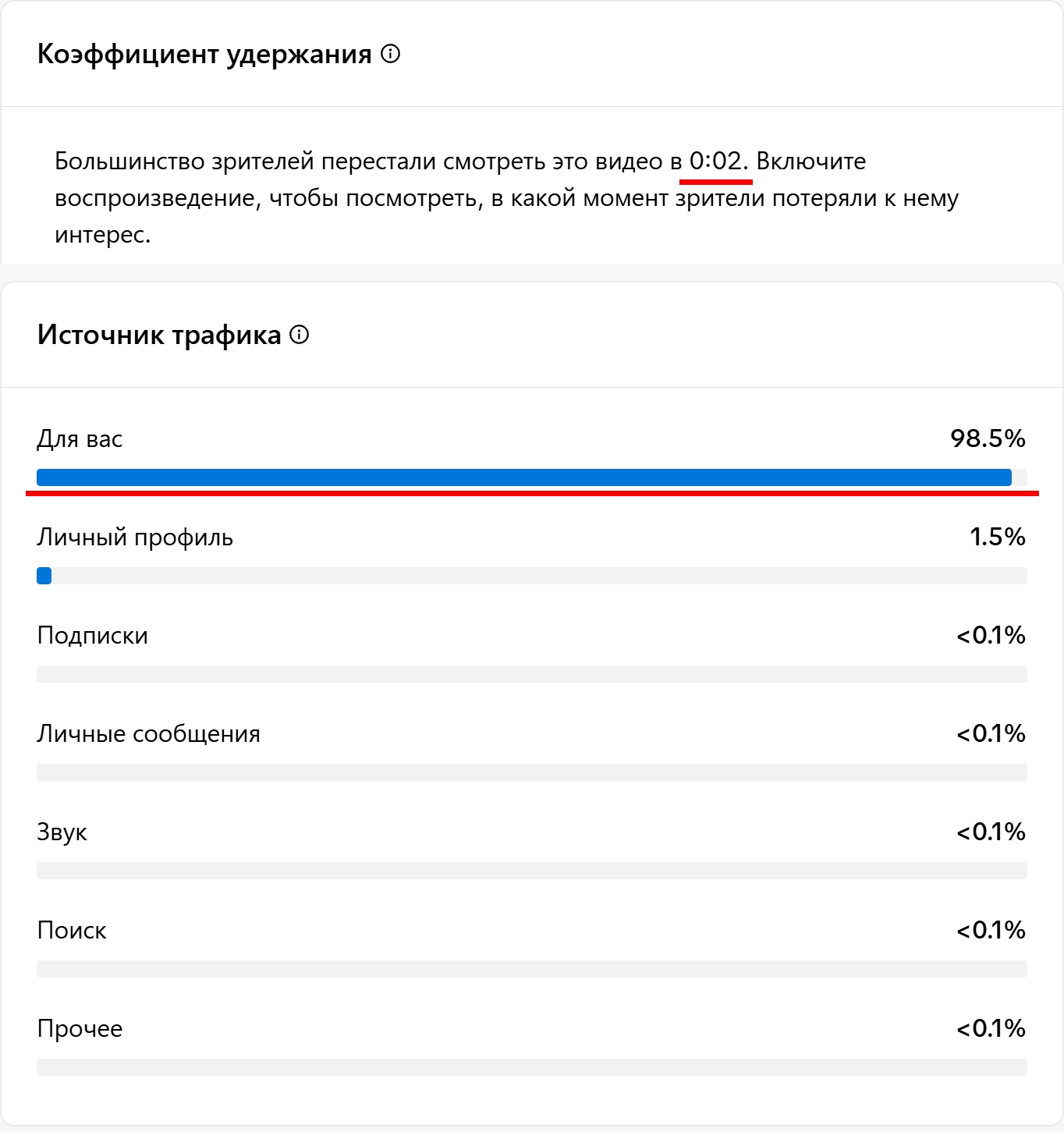
Our video. The screenshot below shows the analytics of our video published on September 22, 2026. It stopped at 202 views, like the video at the start of the article. It got all 202 views on the first day, and there were no new ones over the next four days. This is visible on the views chart, which is not in the screenshot. 98.5% of its views came from the For You feed, so the video did get into the feed. But most viewers left at 0:02.
This video is not the only one. As of September 27, the same account has 14 videos from September 17 and 22. Eleven have between 178 and 202 views, one has 123 and one has 3. One more is hidden with the “Only me” setting and got no views. Seven videos from September 17 and one more from the 22nd are now hidden too, and we did not record how long they were public. This series suggests the views hit a ceiling at about 200. The analytics do not say why the videos’ views stop at this level. We looked at retention only for the video in the screenshot: it got views from the feed, and most viewers left at 0:02. If you see a similar pattern, check the first seconds (see the section “What to change in your next video”).
What we don’t know
Whether a video’s distribution comes in waves, and how big they are. TikTok does not write about this.
How quickly viewer reactions reach the system. Engineers at ByteDance, TikTok’s owner, described the Monolith recommendation system 5. One part of its parameters is updated at intervals on the order of a minute 5. Another part, once a day 5. But the experiment with update intervals there was run on an open dataset of ad clicks. And the paper does not say whether the TikTok feed runs on Monolith 5.
How a new video starts out. The papers by Boeker and Urman 4 and by Karan Vombatkere’s team 6 study the viewer’s feed, not what happens to a video. According to Vombatkere, for new users 30 to 50% of the first thousand videos are picked based on their interests 6. So a video can also reach people who have not watched your topic before. We did not find a separate study on how a new TikTok video starts out.
Frequently asked questions
Where to start
- Have past videos? Check their analytics to see where viewers leave 20.
- Shoot a new video and show the main point in the first 3 seconds 22.
- Add hashtags that match the video’s topic and a suitable sound.
- Publish the video on an active day, no earlier than two hours before your followers’ peak. No followers? Look at your viewers’ most active times 21.
- After one day and after two days, record views, retention and the share of the For You row in the traffic sources.
- Repeat with the next videos. After several videos, compare which formats and topics work better.
- If a video gets no views, leave it up and change the next one instead of re-uploading this one.
Lots of videos, and you edit a separate version for each account? The sound and frame edits for each version can be handed to Video Unique Booster. The editing and the idea stay with you. How to process many videos in one run is covered in the article on batch video processing (in Russian).
Related reading:
- 0 views on TikTok (in Russian)
- 0 views on a new account (in Russian)
- checking a video for uniqueness (in Russian)
Sources
The numbers in square brackets in the text refer to this list. TikTok’s rules are cited in the version in effect since September 24, 2026.
- TikTok. Introduction to the TikTok recommendation system. Transparency Center. Transparency Center page ↩︎
- TikTok Newsroom. How TikTok recommends videos #ForYou. 2020. TikTok article ↩︎
- TikTok Newsroom. 5 tips for TikTok creators. 2020. TikTok article ↩︎
- Boeker M., Urman A. An Empirical Investigation of Personalization Factors on TikTok. The Web Conference 2022 (WWW ’22). arXiv preprint ↩︎
- Liu Z., Zou L., Zou X. et al. Monolith: Real Time Recommendation System With Collisionless Embedding Table. ORSUM@ACM RecSys 2022. arXiv preprint ↩︎
- Vombatkere K., Mousavi S., Zannettou S., Roesner F., Gummadi K. P. TikTok and the Art of Personalization: Investigating Exploration and Exploitation on Social Media Feeds. ACM Web Conference 2024. arXiv preprint ↩︎
- Zhao Z. Analysis on the “Douyin (Tiktok) Mania” Phenomenon Based on Recommendation Algorithms. E3S Web of Conferences, vol. 235, 2021. DOI record ↩︎
- TikTok. Community Guidelines: Integrity and Authenticity. Community Guidelines page ↩︎
- TikTok. Community Guidelines: Accounts and Features. Community Guidelines page ↩︎
- TikTok. Community Guidelines: Enforcement. Community Guidelines page ↩︎
- Bolshoy Vopros. Thread “Can you re-upload a video on TikTok” (in Russian). Question thread ↩︎
- CPA.Club. How to get into TikTok recommendations: secrets and tips (in Russian). 2024. Forum thread ↩︎
- Olga Ulyanova. How to get into TikTok recommendations. TikTok algorithms (in Russian). YouTube. YouTube video ↩︎
- crystal.beetle. How to get into Tik Tok recommendations (in Russian). YouTube. YouTube video ↩︎
- Bolshoy Vopros. Thread “How does TikTok count views” (in Russian). Question thread ↩︎
- sindikat. How to Get into TikTok Recommendations in 2026: All Methods (in Russian). YouTube. YouTube video ↩︎
- sindikat. How to Get into TikTok Recommendations: TikTok Algorithms in 2024 (in Russian). YouTube. YouTube video ↩︎
- sindikat. How to Get into TikTok Recommendations? The Secret to Big Views on Your Videos in 2025 (in Russian). YouTube. YouTube video ↩︎
- sindikat. How to Get into TikTok RECOMMENDATIONS? How the ALGORITHMS Work in 2025 (in Russian). YouTube. YouTube video ↩︎
- TikTok Creator Academy. Using analytics to improve video performance (in Russian). TikTok article ↩︎
- TikTok Creator Academy. What TikTok analytics are for (in Russian). TikTok article ↩︎
- TikTok Creator Academy. 8 tips to help you become a successful TikTok creator (in Russian). TikTok article ↩︎
- TikTok Creator Academy. Why isn’t your video getting into the For You feed? (in Russian). TikTok article ↩︎
- TikTok. Community Guidelines: For You Feed Standards. Community Guidelines page ↩︎
- Gde Kurs. How to view Reels, Shorts and TikTok analytics in 2026 (in Russian). vc.ru, 2025. vc.ru article ↩︎
- TikTok Creator Academy. Understanding TikTok Analytics for Creators. TikTok article ↩︎
