
The TikTok algorithm decides which video to show next in the For You feed 1. TikTok has described how it does this, but it has not published weights or thresholds. The rest is known from a 2021 leak, an investigation with bot accounts and academic papers. We have sorted these sources by reliability.
In short. TikTok itself names watching a longer video to the end as a strong signal 1. It does not treat follower count or past high-performing videos as direct factors 1. It does not recommend duplicated content 1. In its Creator Academy, TikTok writes that watch time is weighted more heavily than likes, comments and shares 11. The Wall Street Journal investigation with bot accounts also named watch time as the main signal 7. The leaked internal document from 2021 shows which actions make up a video’s score, but gives no weights 4. Below we go through what is confirmed and what is not.
Who this article is for
For creators who want to understand how the algorithm picks videos for the For You feed and to tell confirmed facts from retellings. How a video gets into the For You feed in the first hours after publishing is a separate topic. Free promotion techniques are covered in our article TikTok promotion (in Russian). This article covers the signals themselves and what is known about their weight. How to check your own video against them is in the section “Where to start”. A separate section is for those who publish one video on several accounts.
TikTok Ads Manager is not covered here. Ads have their own delivery rules.
Video Unique Booster for Windows: hundreds of unique copies in one goBy hand, you edit copy after copy. The program creates them in batches. Each copy gets its own image, sound, metadata and duration.
Video Unique Booster: video uniquification for WindowsYou add a video and set the setting ranges. The program creates hundreds of copies. Each has its own image, sound and duration.
Hundreds of unique copies from one original videoThe manual way runs into one problem. Each copy has to be edited separately. More copies take more time.
Unique video copies for TikTok, YouTube and InstagramYou set the setting ranges once. Then the Windows program creates copies in batches. Hundreds in one go.
Video uniquification for Windows – Video Unique BoosterYou add one video. The program creates hundreds of copies. Each has its own image, sound, metadata and duration.
How we know this
We are the Video Unique Booster team. We make a program that creates unique copies of videos. We have run account networks on Instagram and X. Our TikTok experience is small. In September 2026 we tested on one account of our own whether uniquified copies of videos gain views. We did not send the traffic from this account anywhere. So what we know about the TikTok feed itself is mostly what has been published. What we saw ourselves is described in the section on duplicates and in the section “Where to start”.
The article contains two measurements of our own: how much typical video edits shift the image fingerprint (section on duplicates) and a review of 19 search results. The article also analyses the stats of a video from our TikTok account (section “Where to start”). Everything else comes from TikTok documents, academic papers, retellings of investigations, forums and videos. Borrowed claims carry a source number. Quotes from the reviewed search-result articles have no number; their sites are named in the section on our review. Our own conclusions are marked. Research was completed on September 27, 2026.
There are three kinds of sources, and their reliability differs.
- TikTok’s own documents. A 2020 Newsroom article, the page about the recommendation system, the For You feed eligibility standards, other Community Guidelines and the Creator Academy 12311121718. This is confirmed information. The Community Guidelines are cited in their August 2026 version; we read the other pages in September 2026. They contain no weight values.
- The leak and the investigation. The New York Times described an internal TikTok document in December 2021 45. TikTok confirmed that the document was authentic 45. In July 2021, The Wall Street Journal published an experiment with a hundred bot accounts 67. Both pieces are behind a paywall. We read their public retellings.
- Academic papers. They are based on experiments with bots and on data donated by users themselves 8910.
We also reviewed six articles and 13 YouTube videos found for the Russian query “алгоритм тик ток” (TikTok algorithm) and related ones. What they say is counted in the section on our review.
How the TikTok algorithm works: five steps and the signals
In its Newsroom article, TikTok names three groups of signals: user interactions, video information, and device and account settings 1.
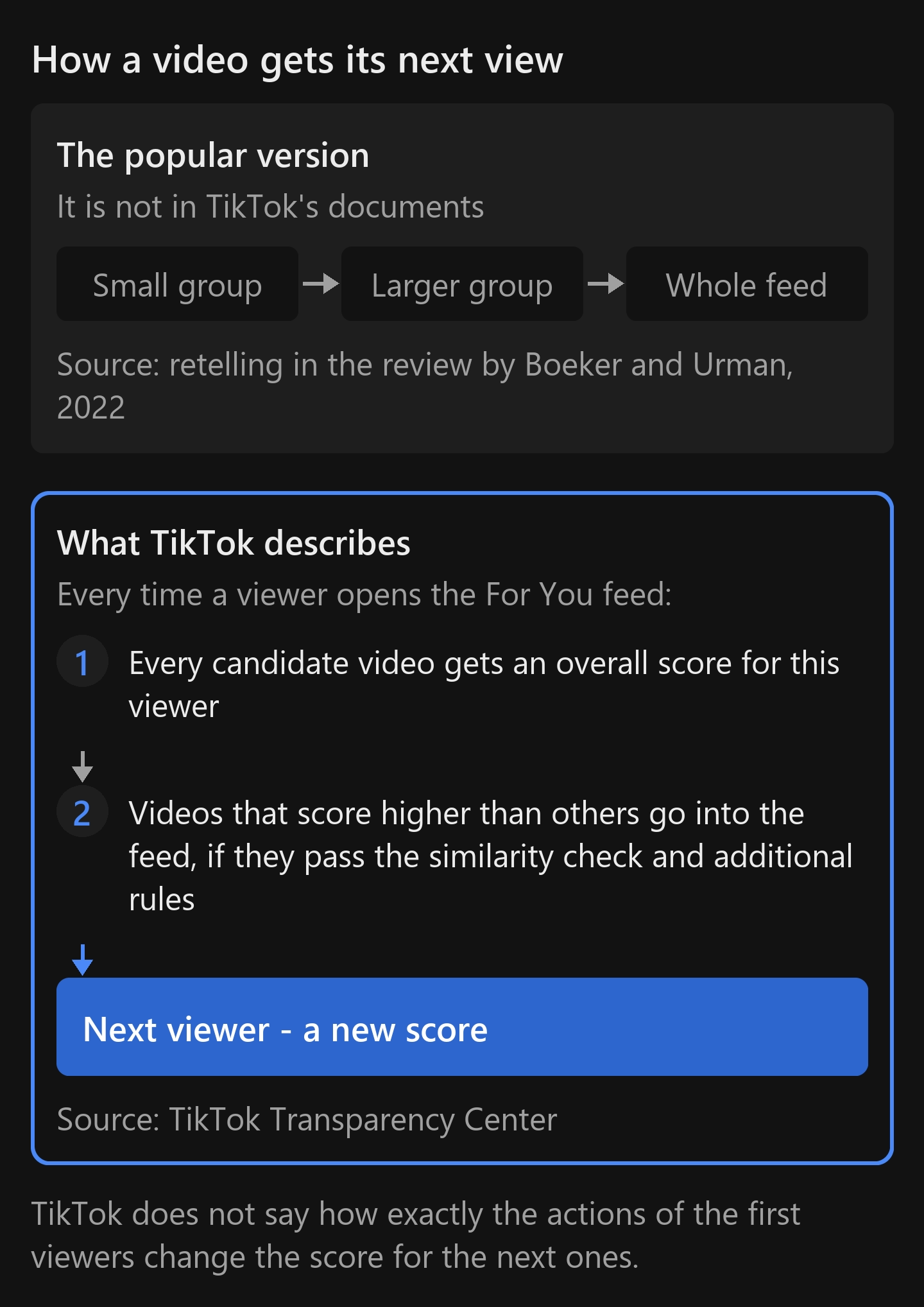
Every time a viewer opens the feed, the system goes through five steps 2. It selects videos eligible for the feed. It predicts what the viewer will do with each one. It ranks the videos by an overall score. It replaces videos that are too similar with others. In the fifth step, the system applies additional recommendation rules, and it does so at different stages 2. The similarity check works within one viewer’s feed. For example, videos with the same sound count as too similar 2.
TikTok lists the signals themselves at the end of the same page 2:
- What the viewer is predicted to do with the video. Like it, share it, comment on it or mark it as not interested. Follow the creator or visit their profile. Watch it to the end, skip it or add it to favorites. Watch it for a certain time. Tap the sound.
- What the viewer did before. Which videos they recently watched, finished and skipped, which ones they liked. Whom they follow.
- Video information. Publishing time, region, the creator’s language, sound, length, hashtags. The Newsroom article adds captions 1.
- Viewer settings. Region, device language, operating system.
The predictions add up to an overall score of the video for this viewer 2. The page gives no weights for individual predictions.
How this turns into “the video gets pushed further”. TikTok’s documents contain no separate decision like “show this video to another thousand people”. There is a score of the video for each next viewer 2. Our conclusion: a video gets its next view when, for the next viewer, its score is higher than that of other videos. TikTok does not say how exactly the actions of the first viewers change the video’s score for the next ones. It only says that a viewer may be shown a video that was well received by other people with similar interests 1. The popular version talks about stages: first a small group, then a larger one, then the whole feed. It is retold in the literature review of the paper by Boeker and Urman 8. It comes from a 2021 article by Zhao 25. We could not open the article itself: the journal’s site denied access, and we verified its record only through the DOI registry. TikTok’s page on the recommendation system has no such stages 2.
Articles and videos about TikTok talk about a “test pool”, most often of 200-300 viewers or views. TikTok’s page says nothing about it 2. We searched the full text of the page: the phrases “test audience”, “small audience” and “gradual” do not appear there.
What weighs more: three comparisons from TikTok
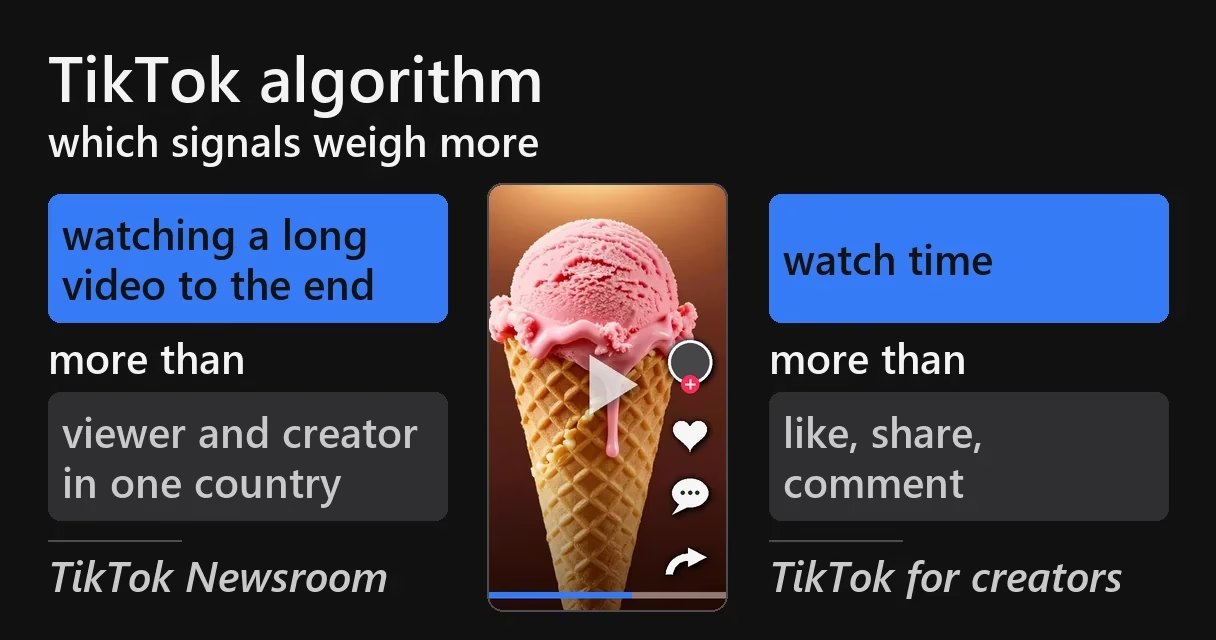
The first comparison is in the Newsroom article 1. A strong indicator of interest weighs more than a weak one. An example of a strong one: the viewer watched a longer video from beginning to end. An example of a weak one: the viewer and the creator are in the same country. The second comparison is in the same article 1. Language, country and device type weigh less than other data, because viewers do not express their interest through these settings. For a creator, this means: what the viewer did with the video weighs more than who and where they are.
The third comparison is in TikTok’s Creator Academy 11. It lists what a creator should look at in analytics. The retention rate is named the most important: what share of the video viewers watched. The second most important is engagement: likes, comments and shares. And right after engagement it says that watch time is weighted more heavily than likes, comments and shares.
None of these documents gives a completion threshold in percent.
The formula from the “TikTok Algo 101” leak
In December 2021, The New York Times described TikTok’s internal document “TikTok Algo 101”. Retellings quote a formula for scoring a video from it 45:
Plike × Vlike + Pcomment × Vcomment + Eplaytime × Vplaytime + Pplay × Vplay
The New York Times did not explain the letters 5. The Batch reads them this way. P and E are the model’s predictions: whether the viewer will like the video, comment on it, how long they will watch it, whether they will play it at all. V is possibly the value of such an action 5. Gizmodo reads playtime differently: as the video’s length 4. According to Gizmodo’s retelling, the system gives each video a score and shows the videos with the highest one 4.
The retellings give no weight values. Follower count is not in the formula. But the formula is simplified: according to the document itself, the real equation is much more complicated 45. Both retellings point this out. So no conclusion about followers can be drawn from it.
According to Gizmodo’s retelling, the system is aimed at two metrics 4. The first is retention: whether the user comes back to the app. The second is time spent in it. The formula tells a creator little: the score includes different viewer actions. In The Batch’s reading, watch time enters it as a separate term 5.
What experiments with bots and viewer data showed
The Wall Street Journal, 2021. The experiment used a hundred new bot accounts. Each was assigned its own topic. A bot lingered on videos of its topic and skipped the rest. The main signal, according to the investigation’s findings, is the watch time of each video 7. According to The Batch’s retelling, the largest weights went to watch time, the number of rewatches and pausing during viewing 5.
One bot shows how quickly the feed adapts to an interest. After 3 minutes and 15 videos, the bot kentucky_96 watched a 35-second video about sadness twice. 33 minutes later it had been shown 224 videos 6. By then, 93% of the videos shown to it were about depression and mental health struggles 6. A TikTok spokesperson told the WSJ that the remaining 7% are there to help viewers discover other things 6. The spokesperson also said the experiment does not reflect the behavior of real people, whose interests are more diverse than a bot’s 6. According to kottke.org’s retelling, the feed filled up with videos matched to the bot’s interest within an hour or two 7.
Boeker and Urman, 2022. The researchers also ran bot accounts and compared which factors have a stronger effect: actions, country, language. Following the creator had the strongest effect on recommendations 8. Next come view rate and likes; the paper does not say clearly which of the two is stronger 8.
Vombatkere et al., 2024. This paper is based on data from real users. In a new viewer’s first thousand videos, 30% to 50% of the impressions match their interests 9. The rest is exploration: the system tries topics the viewer has not watched yet.
What this means for a creator. The WSJ bots’ feeds narrowed quickly to the assigned interest 67. For real users, part of the impressions remains exploration 9. What follows is our conclusion; it is not in the paper. Your video may reach not only viewers of your topic. It may also reach people to whom the system is only trying out the topic. The video should make sense to such a viewer, too, who is not yet familiar with the topic. What share of a new video’s impressions such exploration takes has not been measured in the papers we read.
Completion in numbers: what was measured on real viewers
Search results contain completion numbers. One of the reviewed articles says that 83% of users watch at least one video to the end in every session. That is about viewers over an entire session in the app, not about the completion of a single video. The article attributes this number to industry statistics, not to TikTok.
Among the academic papers we read for this article, one measures completion on real viewers: the 2024 paper by Zannettou et al. 10. 347 TikTok users donated their data to the researchers. That is 9.2 million recommendations. 45% of views were watched to the end 10. The median share of a video watched is 82% 10: in half of the views, the viewer watches at least 82% of the video. Almost half of the views reach the end, and in the rest the viewer leaves earlier.
These are overall numbers across all the participants’ views, not a threshold. Compare a video with your own videos: the share of viewers who watched to the end is in the analytics of every video 12.
What is not in TikTok’s documents
- Hashtags. TikTok lists them among video information 1. The Newsroom article says nothing about their weight 1.
- Seconds. “The first 1-3 seconds decide,” says one of the reviewed articles. TikTok’s Newsroom article says nothing about seconds 1.
- Trends. “The only thing that matters is whether the topic is actually trending on TikTok,” says the author of a video about the “new algorithm” of September 2026 14. The word trend does not appear once on TikTok’s recommendation page 2. The Newsroom article mentions trending topics once: a viewer who watches them in the Discover tab refines their own feed 1. TikTok does not describe a separate delivery queue for trends.
Rules on duplicates: one video on several accounts
Some rules concern the video itself rather than how it is watched. Newly uploaded videos and videos under review may not appear in the For You feed 1. And in the section on feed diversity, TikTok writes: “We also don’t recommend duplicated content, content you’ve already seen before, or any content that’s considered spam” 1.
TikTok’s Community Guidelines, August 2026 version, go into more detail. Unoriginal or reused material that adds nothing new is not eligible for the For You feed 17. An example from the rules is videos with someone else’s watermark or logo. Another item is low-quality or minimally edited content 17. A separate rule applies to the account as a whole. An account may not break the rules but still publish a lot of such content. Then TikTok may make the whole account and its videos ineligible for the For You feed 18.
In our assessment, the same file on several accounts is closest to what TikTok calls duplicated content 1. None of the six reviewed articles mentions the rule under which a whole account can be removed from the feed. And two sources in our sample directly advise publishing the same video again. One of the reviewed articles (from 2022) advises uploading the video again with a different sound, cover and caption. The Robert Benjamin channel suggests publishing the same video again two weeks later. It suggests changing the caption and hashtags, and optionally the beginning of the video. It suggests repeating this “two or three times or even more” 14. The advice is about a single account. Is a new caption enough for TikTok to treat the video as new? The rules do not say; they require creative edits 17.
What we saw ourselves. On September 22, 2026, we published seven uniquified copies of videos on one TikTok account of our own. By September 27, six had between 123 and 202 views, and one stayed at zero. The test was recent, so it says nothing about whether TikTok removes a whole account from the feed over time. We have no comparison with unchanged copies on TikTok. In the Instagram network we did not publish videos without uniquification. Before the network, on one account of our own, other people’s videos from other social networks, unedited, soon started getting zero views. We have no exact numbers for this. In our X network, in January 2024, we replaced the media with unique versions and dropped the scheme of main and secondary accounts in one step. According to our change log, traffic grew 14 times after that. There were two changes at once, so we do not know the contribution of each.
TikTok’s documents do not say how it detects reused material. The “similarity check” step 2 is about something else: it makes sure similar videos do not follow each other in one viewer’s feed.
What can be measured, though, is how much an edit changes the video itself. YouTube’s Content ID compares every uploaded video against a database of audio and visual files submitted by copyright owners 22. YouTube does not say how exactly it compares them. One of the open methods is a perceptual hash: a short code of an image that barely changes after re-compression 16. We measured such a fingerprint in September 2026 for an article on checking a video for uniqueness (in Russian) 16. We took four real-footage videos from the open VISION dataset 23, 12 seconds each, and compared the perceptual hash of the copies with the hash of the original over 16 frames. The hash was computed with the phash function of the imagehash library for Python 24. The hash is 64 bits, that is, 64 zeros or ones. The shift equals the number of bits that changed: for the same image it is 0, for a completely different one about 32. Light noise shifted the hash of different videos by 0.1-0.6 bits out of 64 on average, a light brightness edit by 0.5-1.3. Cropping shifted it by 4-7 bits on average, a frame border by 8-12. Mirroring shifted it by 31, almost as much as a completely different image. TikTok does not say whether it uses this kind of fingerprint. But the measurement shows which edits are almost invisible to such a comparison.
Our conclusion: if you need a video on several accounts, each version needs its own edit and its own caption. The rules expect creative edits 17, and making them is up to you.
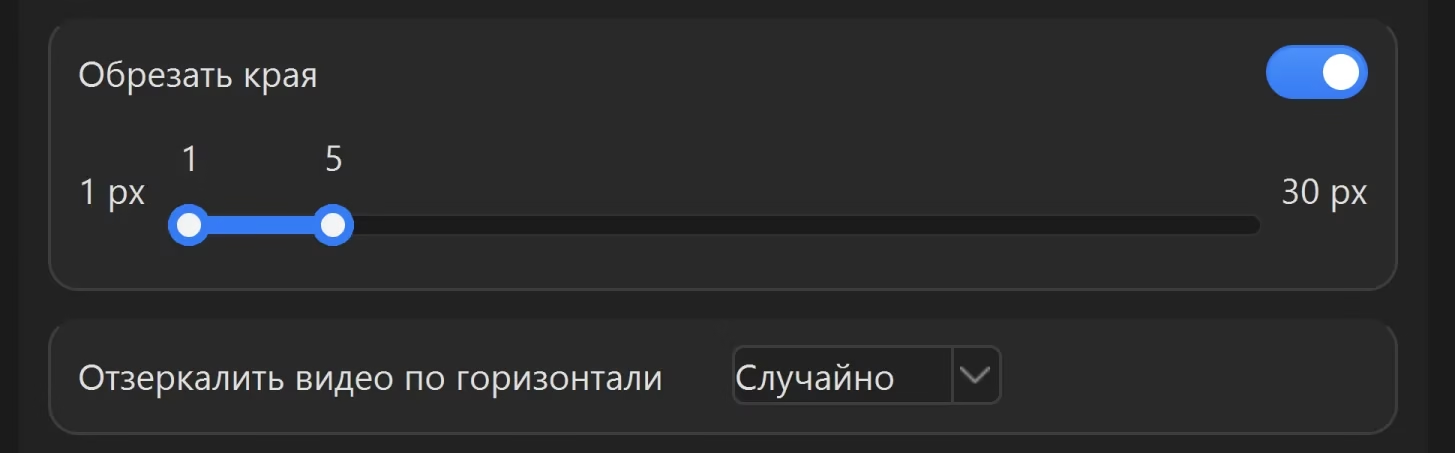
The frame and sound edits for each copy can be handed to our program Video Unique Booster. We sell it, so we will also name its limits. It does not replace editing. The program changes the image and sound on top of your version. For example, it crops the edges of the frame, mirrors, rotates and scales the video, changes its duration, brightness, contrast and saturation, and adds noise. In the audio, it changes the volume, pitch, and the low, mid and high frequencies. If you turn on “Add metadata”, the program writes new metadata to each copy instead of carrying it over from the original. It does this for all copies at once.
Each copy gets its own edit values. Additional audio for each copy is picked at random from your set of sounds. The program prepares the files. It does not publish videos and does not manage accounts.
This approach has a limitation. In the measurement above, it was mirroring that shifted the fingerprint most 16. But the measurement compared a copy with the original. Two mirrored copies of the same video do not differ from each other by mirroring: their reflection is the same. Whether TikTok recognizes such a copy cannot be told from this measurement.
What search results say about the algorithm: our review
We manually tagged 19 sources using one scheme on September 26-27, 2026. For each, we noted whether it gives a completion number or a “test pool” size, whether it cites at least one source, whether it cites the leak or the WSJ, and what it says about followers and about reposting a video.
These are six articles and 13 YouTube videos. The articles come from likestorm.com.ua, vc.ru, pandateam.net.ua, calltouch.ru, postium.ru and web-promo.ua. Three of them rank on the first page of Google for the Russian query “алгоритм тик ток”: we saved the results the same day, language Russian, region Belarus. The other results on that page are videos and a TikTok collection, a forum and a VKontakte post; we did not analyse their text. We found three more articles with a search outside Google, for the Russian query “how the TikTok algorithm works ranking signals”. The videos come from YouTube results for the Russian queries “TikTok algorithm” and “how the TikTok algorithm works” and were tagged by their automatic subtitles. For two videos from the results the subtitles could not be downloaded, and they were not included in the sample.
The sample is small and not random. Of the 13 videos, five are in Russian, four in Ukrainian and four in English. One video does not talk about the algorithm at all, but it is counted in the “of 19”. The pandateam.net.ua page returned a 404 error on a repeat check, so we tagged it from the notes of the first reading.
| What we checked | Sources out of 19 |
|---|---|
| Give a completion number or a “test pool” size | 9 |
| Of these nine, cite at least one source | 3 |
| Cite the 2021 leak or the WSJ investigation | 0 |
| Give a “test pool” size | 6 |
| Treat follower count as a factor in reach | 1 |
| State directly that followers do not affect reach | 2 |
| Say that reposting a video hurts | 3 |
| Say that reposting a video does not hurt | 2 |
The “test pool” appears in six sources. Their numbers differ: 200-300, 200-500, 100-400, 500-600 viewers or views. None of the six links this number to TikTok.
What this means for you. The TikTok documents we read contain no “test pool” numbers and no completion thresholds. Of the nine pieces with such numbers, three cite at least one source. Only one gives a source for the number itself, and it leads to industry statistics, not to TikTok. Planning your publishing around these numbers is not worth it. It is more reliable to check a video by your own analytics; the steps are in the section “Where to start”. Not a single source in the sample cites the 2021 leak or the WSJ investigation.
What we do not know
- The weights. TikTok does not publish them. The formula from the leak dates from 2021 and is simplified 4.
- How accurate the formula is today. The leak is almost five years old. TikTok writes that the signals of its system are constantly updated 2. The video in our sample about the “new algorithm” of September 2026 does not cite TikTok’s documents 14. There is a 2026 Metricool report: 2.3 million posts, more than 92 thousand accounts. According to it, 7 out of 10 views come from the For You feed 21. This is data on where views come from, not on the weights of signals.
- How the experiments carry over to your account. The WSJ and the researchers worked with bots and samples. The papers we read contain no measurements for an individual account.
Frequently asked questions
Where to start
Open your analytics: profile, the menu icon, “TikTok Studio”, the “Analytics” section, “View all” 12. The path is given according to TikTok’s Creator Academy. We checked the names “Traffic source”, “Average watch time” and “Watched full video” on September 27, 2026 against our own account’s analytics in the browser version of TikTok Studio, which we use in Russian. There, the path is “Analytics”, then the “Overview” tab. Then check the video step by step, in order.
- Feed eligibility. If a video has been made ineligible for the For You feed, this is shown in the video’s analytics 3. Then the cause is the rules, not the signals.
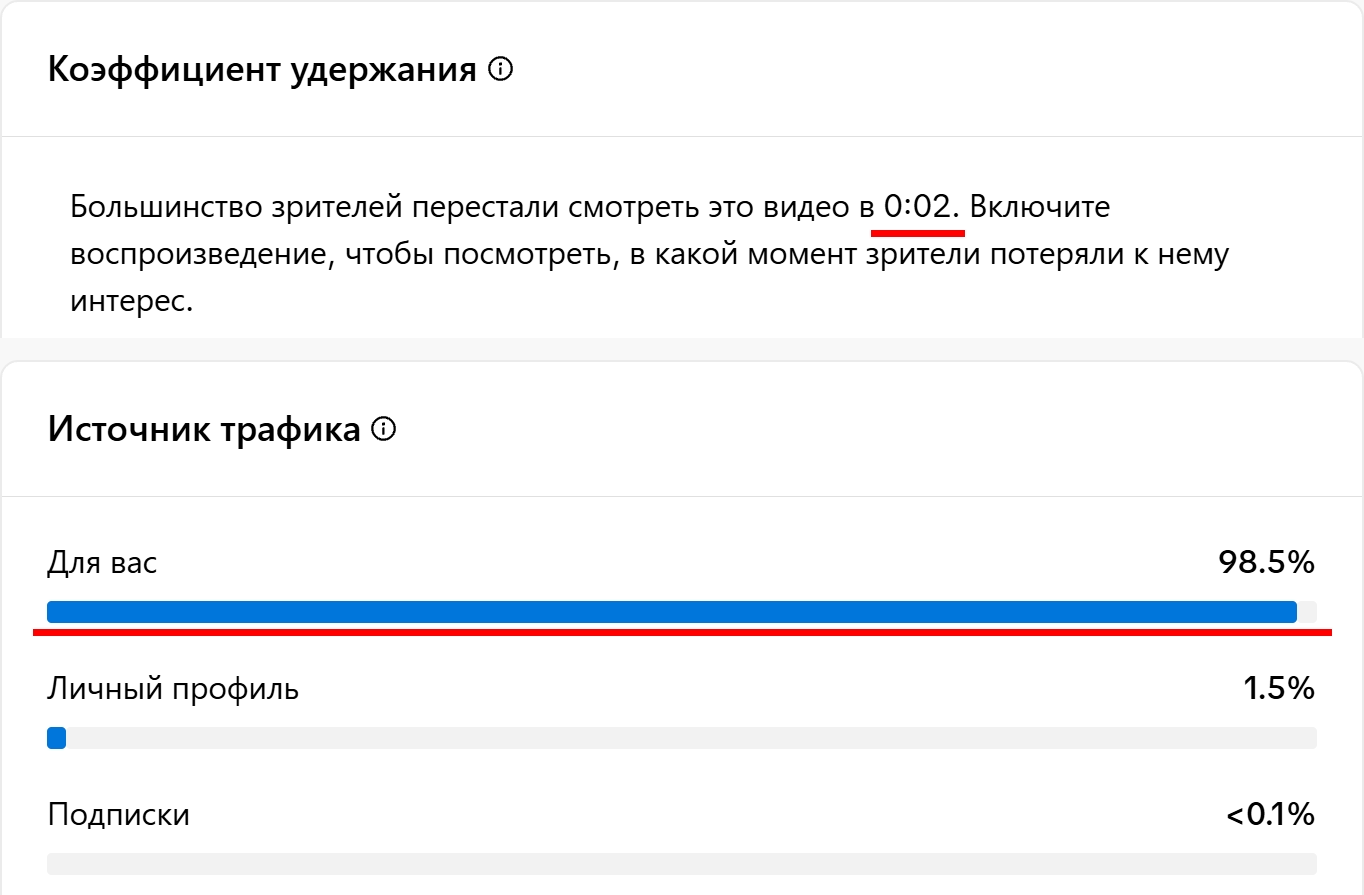
- Traffic sources. Analytics show where viewers came from 11. In the “Traffic source” block, the For You feed is labeled “For You”. Next to it are “Personal profile”, “Following”, “Search” and “Sound”. If almost no viewers come from “For You” and there is no ineligibility notice, retention is not necessarily the problem. TikTok promises a notice in analytics when a video is made ineligible under the feed rules 3. So for reused material without creative edits, a notice is promised 317. Whether there will be one when TikTok simply does not recommend duplicated content 1 is not stated in the documents. If the video repeats one already published, start with the section on duplicates. If not, check retention; that is the next step.
- Retention. “Retention rate” shows what share of the video was watched and where viewers leave 12. Look at the point where the graph drops sharply.
- Average watch time and watching to the end. These are “Average watch time” and “Watched full video” in the video’s analytics 12. Compare them with your other videos that got more views. If there are none, compare with your next videos after the edits. They cannot be compared directly with the numbers from academic papers. “Watched full video” is the share of viewers who watched the video to its last seconds 12. In the Zannettou paper, 45% is the share of views watched to the end, and 82% is the median watched share, not the average 10. These numbers give a general idea of completion, but they are not a TikTok threshold.
What it looks like for us. A video from our TikTok account published on September 22, 2026 had 202 views by September 27. 98.5% of the views came from “For You”. All the views came on the day of publishing; there were no new ones from September 23 to 26. The video’s “Average watch time” is 4.72 seconds, “Watched full video” is 4.4%. The video’s analytics show the line: “Most viewers stopped watching this video at 0:02”. By the steps above, it reads like this: the video is eligible for the feed, viewers from the feed came, and they leave at the very beginning. Our conclusion: this video needs its first seconds reworked. This is a conclusion about one video, not a TikTok rule.
TikTok itself advises what to do next 11:
- Rewatch the point where viewers left.
- Try different kinds of videos.
- Collaborate with other creators and tag them.
- Make quality videos: carefully made, engaging, niche and longer.
- Expand your reach geographically: look at the top five regions of your viewers.
- Publish on your audience’s most active days, no earlier than two hours before the peak. These hours are shown in your follower analytics 11.
New account and zero views? Start with our article 0 views on a new account (in Russian).
Publishing one video on several accounts? Each version needs its own edit and its own caption; that is your work. The frame and sound edits for each copy are prepared by Video Unique Booster. How to process many videos at once is covered in our article on batch video processing (in Russian).
Related reading (in Russian)
- Video uniquification for TikTok
- 0 views on TikTok
- Checking a video for uniqueness
- How to remove metadata from a video
Sources
The numbers in square brackets in the text refer here. The For You feed eligibility standards are cited in their August 2026 version.
- TikTok Newsroom. How TikTok recommends videos #ForYou. 2020. TikTok article ↩︎
- TikTok. Introduction to the TikTok recommendation system. Transparency Center. The page has no date; read in September 2026. Transparency Center page ↩︎
- TikTok. For You feed eligibility standards. Community Guidelines, August 2026 version. For You feed standards ↩︎
- Wodinsky S. Leaked TikTok Doc Reveals Its Obvious Secret to an Addictive Feed. Gizmodo, 2021. A retelling of Ben Smith’s article “How TikTok Reads Your Mind”, The New York Times, December 2021. Gizmodo article ↩︎
- Leaked Info Reveals How TikTok’s Algorithm Works. The Batch, DeepLearning.AI, 2021. The Batch article ↩︎
- TikTok’s Recommendation Algorithm Is Even More Powerful Than YouTube’s (Report). Tubefilter, 2021. A retelling of The Wall Street Journal investigation. Tubefilter article ↩︎
- How TikTok’s Algorithm Figures You Out. kottke.org, 2021. A retelling of The Wall Street Journal investigation. kottke.org post ↩︎
- Boeker M., Urman A. An Empirical Investigation of Personalization Factors on TikTok. The Web Conference 2022 (WWW ’22). arXiv preprint ↩︎
- Vombatkere K. et al. TikTok and the Art of Personalization: Investigating Exploration and Exploitation on Social Media Feeds. The Web Conference 2024 (WWW ’24). arXiv preprint ↩︎
- Zannettou S. et al. Analyzing User Engagement with TikTok’s Short Format Video Recommendations using Data Donations. CHI 2024. arXiv preprint ↩︎
- TikTok. Using analytics as a tool to improve video performance. Creator Academy, September 2026 version. TikTok Creator Academy ↩︎
- TikTok. Introducing TikTok analytics. Creator Academy, September 2026 version. TikTok Creator Academy ↩︎
- Thread “100-200 views and stop” (in Russian). zismo.biz forum, 2023. Forum thread ↩︎
- Robert Benjamin. TikTok’s New Algorithm Changes Explained for September 2026. YouTube. YouTube video ↩︎
- Thread “Can you use many hashtags on TikTok?” (in Russian). zismo.biz forum, 2022-2023. Forum thread ↩︎
- Video Unique Booster. Checking a video for uniqueness: a fingerprint measurement on four videos (in Russian). 2026. Blog article ↩︎
- TikTok. Integrity and Authenticity. Community Guidelines, August 2026 version. Integrity and Authenticity guidelines ↩︎
- TikTok. Accounts and Features. Community Guidelines, August 2026 version. Accounts and Features guidelines ↩︎
- TikTok for Business. 9 creative tips to drive auction ad performance. TikTok for Business blog. TikTok advice for ads ↩︎
- Thread “No views” (in Russian). zismo.biz forum, 2021. Forum thread ↩︎
- Metricool. TikTok Study 2026. Metricool study ↩︎
- YouTube. How Content ID works. YouTube Help, read in September 2026. YouTube Help ↩︎
- Shullani D. et al. VISION: a Video and Image Dataset for Source Identification. EURASIP Journal on Information Security, 2017. Dataset paper ↩︎
- Buchner J. imagehash: a perceptual hashing library for Python. Library code ↩︎
- Zhao Z. Analysis on the “Douyin (Tiktok) Mania” Phenomenon Based on Recommendation Algorithms. E3S Web of Conferences, vol. 235, 2021. DOI record ↩︎
- Robert Benjamin. TikTok’s NEW Algorithm Explained For 2026. YouTube, March 2026. YouTube video ↩︎
